

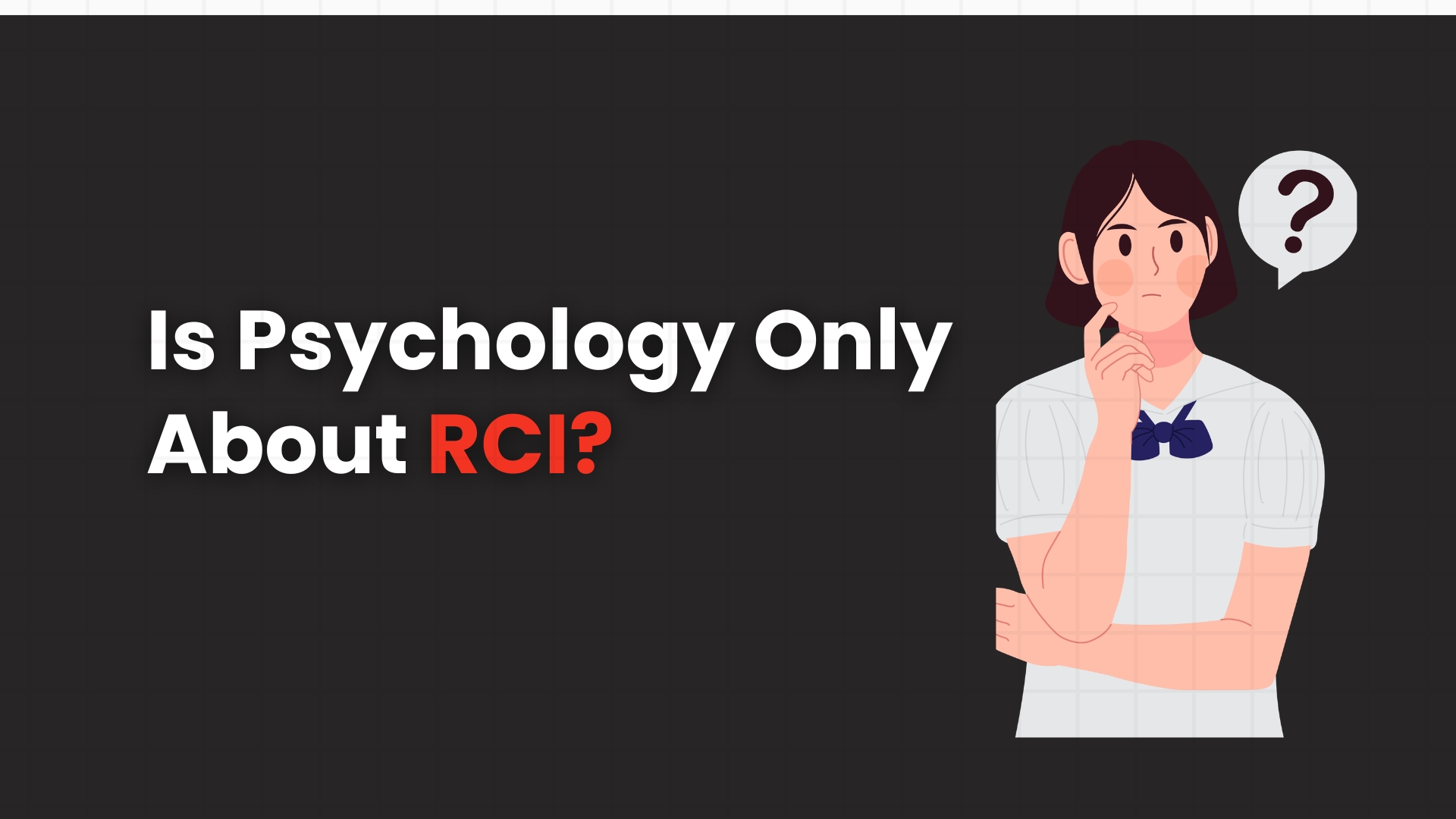
Is Psychology Only About RCI? Understanding Skills, Ethics & Practical Learning
Recently, a conversation with a fellow psychology professional made me think deeply about how we look at identity and success in the field of psychology.
Within a few minutes, the discussion moved toward one common question:
“Are you RCI registered?”
This question is important, but it also made me reflect:
Have we started measuring an entire psychology professional only through one credential?
Before anything else, let us acknowledge, RCI registration has a significant role. It helps regulate specific areas of professional practice, especially clinical psychology, and ensures required standards and guidelines are maintained.
RCI matters. Standards matter. Ethical practice matters.
But a bigger question is:
Is Psychology Only Limited to One Registration?
Psychology is one of the most diverse fields dedicated to understanding human thoughts, emotions, behaviour, relationships, and well-being.
Beyond one pathway, psychology includes:
- Counselling professionals supporting emotional wellness
- Researchers discovering new insights about human behaviour
- Educators shaping future psychology learners
- Organizational psychologists improving workplaces
- Coaches helping individuals achieve personal growth
- Community professionals creating awareness and support
- Each contribution strengthens the field.
A Degree Can Give Knowledge, But Experience Builds a Professional
Today, many people complete degrees and collect certificates, but the real challenge begins when they meet real human problems.
Because psychology is not only about remembering theories.
A person struggling with anxiety does not only need definitions from textbooks.
Someone going through relationship challenges does not only need concepts.
A person facing emotional breakdown needs:
✓ Deep listening
✓ Empathy
✓ Communication skills
✓ Practical understanding
✓ Ethical decision-making
✓ Real-world exposure
A qualification can represent education, but continuous learning, supervision, practice, and experience develop competence.
The Missing Gap Between Education and Application
Many psychology learners complete their academic journey but still ask:
“How do I actually conduct a counselling session?”
“How do I understand a client's real problem?”
“How do I apply psychological techniques practically?”
This gap exists because psychology is a human-centered profession.
Books teach concepts.
Practice teaches understanding.
Knowledge tells you what psychology is.
Experience teaches you how psychology helps.
At NuroSpark, We Believe in Practical Psychology
Our vision is simple:
Learn Psychology. Understand Yourself. Transform Lives.
We believe psychology education should create professionals who are:
- Skilled, not just certified
- Compassionate, not just qualified
- Ethical, not just knowledgeable
- Practical, not just theoretical
The future belongs to professionals who combine education with experience.
The Future of Psychology Needs Collaboration, Not Comparison
Instead of only asking:
“What registration do you have?”
Maybe we should also ask:
“What difference are you creating?”
“How are you improving yourself?”
“How responsibly are you helping people?”
Because the strength of psychology lies in diversity.
Registration matters.
Education matters.
Ethics matter.
Experience matters.
Skills matter.
The future of psychology will grow through learning, collaboration, respect, and one shared mission:
Improving human lives.
— NuroSpark
Igniting Minds. Transforming Lives.
.jpg)
.jpg)
.jpg)
.jpg)

.jpeg)




.jpeg)
.jpeg)






.jpg)
.jpg)
.jpg)
.jpg)

.jpg)
.jpg)
.jpg)
.jpg)
.jpg)
.jpg)